
Run a Hydra data node and contribute to the network.
Node Operators
Hydra nodes are the distributed backbone of the intelligence network. Anyone can run a data node — contributing real-time OSINT and military intelligence data from 10+ sources, serving it directly to clients, and optionally submitting it to the Hydra network for rewards.
What Nodes Do
A Hydra node is a lightweight Go binary that:
- Collects data from 10 intelligence sources (ADS-B, AIS, USGS, OTX, Telegram, and more)
- Normalises it into the Hydra signal schema
- Serves it directly to your clients via REST API and WebSocket on port 4001
- Submits it to the Hydra network (public mode), where it is cross-checked against other nodes
- Gets rewarded based on data quality, uptime, and contribution volume
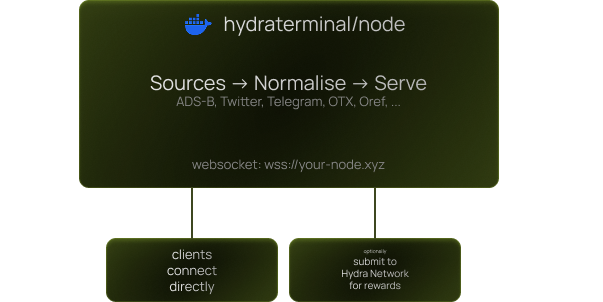
Two Operating Modes
| Feature | Private Mode | Public Mode |
|---|---|---|
| Platform registration | Not required | Required |
| Serves clients directly | Yes | Yes |
| Submits data to network | No | Yes |
| Earns rewards | No | Yes |
| Heartbeat reporting | No | Yes |
| Visible on leaderboard | No | Yes |
| Dashboard management | Local only | Full remote |
Both modes run the same data collection, normalisation, and serving pipeline. The only difference is whether the node participates in the network.
Benefits of Running a Node
| Benefit | Description |
|---|---|
| Direct data access | Serve data directly to your clients — no Hydra API middleman |
| Unlimited throughput | No rate limits when connecting to your own node |
| Earn rewards | Public nodes earn tokens proportional to data quality and uptime |
| Full control | Choose which sources to enable, configure polling intervals, and tune performance |
| Geographic coverage | Nodes in different regions receive data faster from nearby sources |
How Nodes Improve the Network
When multiple nodes contribute data for the same stream, the network gains:
- Redundancy — if one source goes down, others cover
- Accuracy — cross-node validation surfaces anomalies and bad data
- Freshness — competing nodes drive faster update cycles
- Geographic coverage — nodes in different regions catch events sooner
Who Should Run a Node?
Nodes are best suited to:
- Technical users comfortable running a binary on a VPS or server
- Organisations building products on top of Hydra data
- Developers who want maximum API access without rate limits
- Anyone who wants to contribute to the intelligence network and earn rewards
Next Steps
- Requirements — hardware and software prerequisites
- Setup Guide — step-by-step installation and registration
- Configuration — full YAML configuration reference
- Reverse Proxy — expose your node securely with Nginx, Caddy, or Traefik
- Rewards & Incentives — how node operators earn tokens